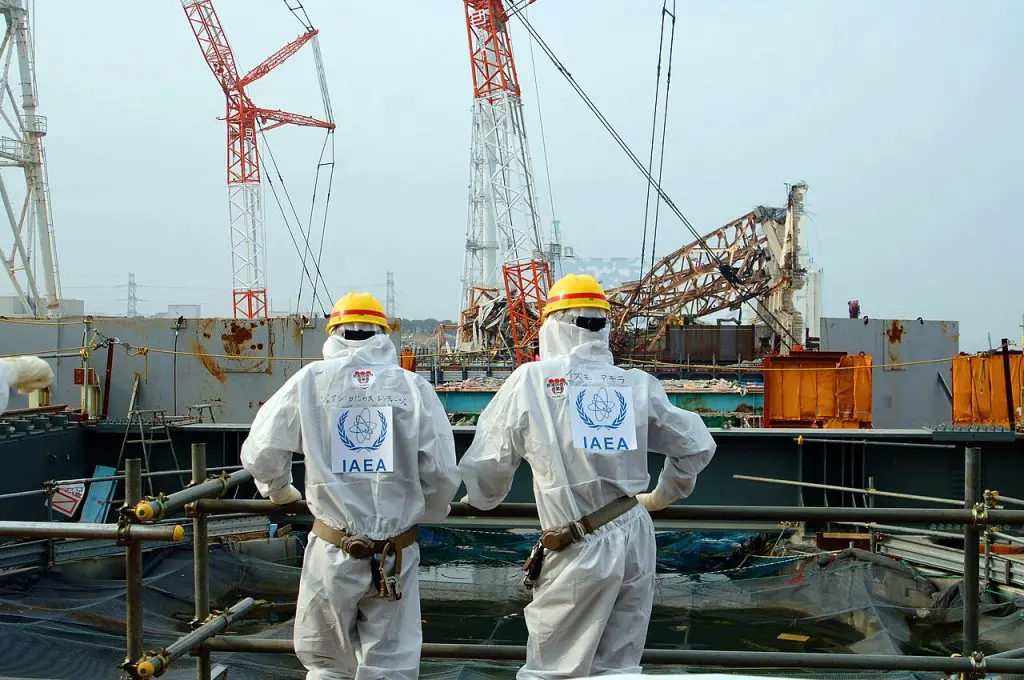
Two IAEA experts examine recovery work on top of Unit 4 of TEPCO's Fukushima Daiichi Nuclear Power Station in 2013 as part of a mission to review Japan's plans to decommission the facility. Photo by Greg Webb / IAEA
Southeast Asia is giving nuclear power a second chance, 15 years after the Fukushima disaster in Japan.
Rising electricity demand, energy shocks and decarbonisation commitments have spurred policymakers across the region to revive their long-stalled nuclear plans.
At the centre of these plans are so-called small modular reactors, or SMRs, which are designed to generate up to 300 megawatts (MW) of electricity per unit – roughly one-third the capacity of conventional large reactors.
The much-hyped technology promises to deliver clean, firm baseload power without all the risks associated with earlier nuclear plants. Apart from being less space-intensive, SMRs are supposedly cheaper, faster to build, safer and easier to contain in accidents than older models.
SMRs started entering power planning documents across Southeast Asia in 2022, when Vietnam proposed including them in its energy mix after 2030 and the Philippines initiated SMR feasibility studies.
Around the same time, Singapore, which scrapped its nuclear plans in 2012 after concluding that the densely populated city-state had no suitable sites for a reactor, mentioned SMRs in its energy supply projections for the first time, while Thailand pivoted from exploring conventional reactors to SMRs.
The technology has also gained traction in Malaysia and Indonesia, with interest accelerating sharply in the past two years, spurred by AI-driven demand.
Last year, Indonesia, where data centre capacity is expected to grow ninefold by 2035, updated its longstanding stance on nuclear from “a last-resort option” to a “balancing” role in supporting its decarbonisation objectives. Grenata Louhenapessy, executive vice president of regulatory affairs and policy at PLN, Indonesia’s state-owned utility, outlined the change at an event in Jakarta in September.
Under PLN’s latest electricity plan, 500MW of new nuclear capacity is set to come online by 2034 – reaching up to 7 gigawatts (GW) by 2040. Indonesia has already planned to deploy SMRs on two sites in Sumatra and Kalimantan.

Lingering questions on costs, safety and waste
Despite the hype, the economic case for SMRs, which depends on factory-based manufacturing at scale, remains unproven, according to a new paper by German thinktank Agora Energiewende.
There are currently over 80 competing SMR designs under development and only two are operational – a pressurised water reactor and a high-temperature gas-cooled reactor, located in Russia and China, respectively.
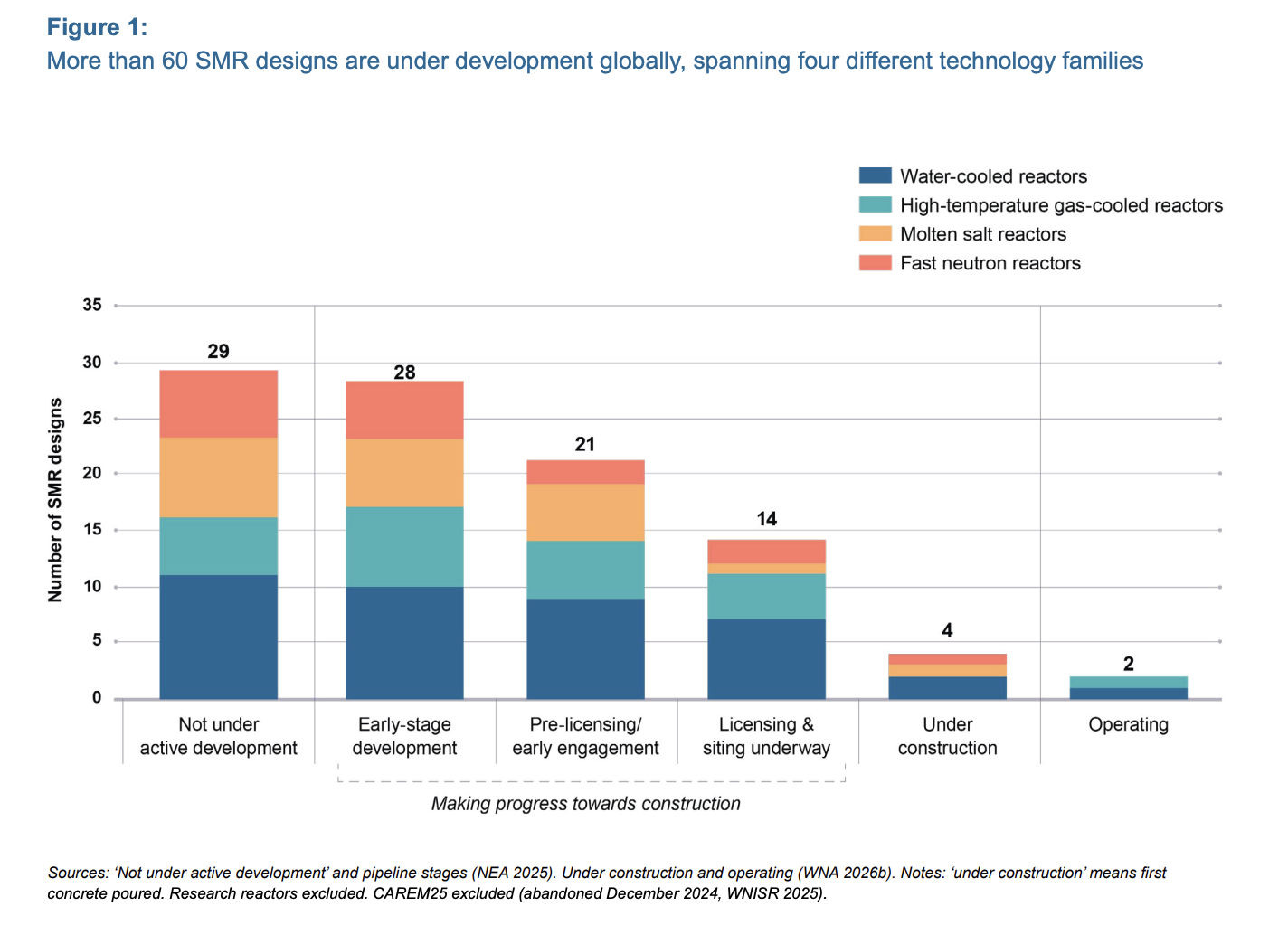
“Even optimistic forecasts place commercial deployment in the mid-2030s, with meaningful capacity only expected after 2040,” said the report’s author Mathis Rogner, Agora Energiewende’s programme lead for power system transformation.
Based on his estimates, first-of-a-kind units are projected to cost roughly US$18,000-19,700 per kilowatt (kW) – several times more than conventional large reactors or solar-plus-storage.
While SMR’s proponents assert that smaller cores and passive safety features can reduce the risk of Fukushima-like accidents, independent safety reviewers have argued that novel coolants and fuel forms could create new technical hazards.
Asean also currently lacks a transboundary nuclear liability framework to cover the residual risks of a nuclear meltdown or radioactive leak that cannot be fully eliminated by preventive measures.
“It is important to distinguish nuclear liability from the related but distinct fields of nuclear safety and security,” international law firm Stephenson Harwood wrote in a report published by its Singapore office.
“A state may have world-class safety standards, but if a low-probability, high-consequence accident causes transboundary damage, the absence of a transboundary liability framework may leave foreign victims without legal recourse.”
To date, only the Philippines has signed on to the Vienna Convention on Civil Liability for Nuclear Damage, which sets the global minimum standards for financial compensation in the event of an accident.
“We’re close to each other. Radiation can be brought to another country through air or through water,” said Erwin Teshiba Tulfo, chairperson of the senate committee on energy in the Philippines, the only Asean nation with a standing nuclear plant. “That’s what our people are afraid of, our neighbours.”
He added: “We just keep on saying nuclear power is safe, but the question remains: how safe is it if there is a nuclear meltdown? How will radiation affect the community, other countries and our neighbours? We must answer these questions.”
Like other Southeast Asian countries, the Philippines presently lacks nuclear waste disposal capacity. To gain the trust of the public, it will have to learn from other countries to develop domestic capability, he said.
But others believe that concerns around nuclear waste management should not stand in the way of advancing discussions.
“[Nuclear waste] shouldn’t be the showstopper,” said Chung Keng Yeow, director of Singapore Nuclear Research and Safety Institute. “For Singapore, we are looking at all the solutions, including keeping the waste ourselves, having a regional repository or a takeback system.”
Russia remains the only major nuclear supplier country that offers spent fuel take-back, while no operational regional repository currently exists in the world.
Technology and fuel lock-in risks
Asean nations are currently keeping their options open by signing cooperation agreements with multiple potential nuclear reactor suppliers.
However, experts warn that there are limits to this hedging strategy given the nature of nuclear infrastructure, which inherently locks countries into long-term technological and fuel supply partnerships.
Mahadi Sugiono, a lecturer at the department of international relations, Universitas Gadjah Mada Indonesia, has argued that nuclear energy forces Southeast Asian countries to pick sides – a reality they have long avoided.
“It is common for a country to buy Russian fighter jets, host US military exercises and welcome Chinese investment simultaneously,” wrote Sugiono. “Nuclear breaks this pattern.”
“A country operating an American reactor cannot load Russian fuel; a Chinese SMR cannot be regulated under US standards. Once a country chooses a supplier, it effectively adopts a 60-year ‘geopolitical package’ involving fuel cycles, safety frameworks, financing terms and strategic alignment.”
Presently, Russia and China are the only two countries with experience in operating SMRs and could offer integrated financing and construction packages that can cover the bulk of upfront costs, while deployment by the US and its allies, including South Korea and Japan, remains nascent.
Southeast Asia also faces practical and legal constraints in diversifying its nuclear fuel suppliers.
Russia currently dominates the fuel supply for SMRs, as it is home to the world’s only commercial-scale production capacity for high-assay low-enriched uranium – a higher potency fuel required by many advanced non-water-cooled designs – and controls around 46% of global uranium enrichment capacity.
To prevent weapons-grade nuclear proliferation, “123 Agreements”, which govern civil nuclear cooperation with the US, also restrict uranium enrichment and spent fuel processing, further limiting national autonomy over the fuel cycle across the region. Five member states – Singapore, Indonesia, Thailand, Vietnam and the Philippines – have signed such agreements with the US.
“Technological lock-in in the civil nuclear electricity industry is, to my understanding, a requirement for the sake of safety assurance in both the construction and operational stages,” said Zha Daojiong, professor of international political economy at Peking University, who is also a visiting senior fellow with Singapore-based research institution ISEAS–Yusof Ishak Institute.
“A nuclear reactor is a technology set that is worked out by engineers before it has a corporate or country brand name,” he told Green Central Banking. “As such, notions such as dependence, security or insecurity ought to be seen as secondary to assurance of safety and pursuit of cost control, among other non-political or sensitive considerations.”
Furthermore, existing SMR designs have not fully taken into account the region’s exposure to natural disaster and climate change risks, said Dinita Setyawati, energy thinktank Ember’s external affairs and strategic impact lead for Asia.
“Much of the region sits on active seismic zones and in the path of intensifying tropical cyclones, conditions that were not design assumptions for most of the reference plants being proposed,” Setyawati told Green Central Banking. Rigorous hazard assessments need to precede financing and deployment commitments, she said.
“Fukushima showed that even a country with world-class engineering and a mature regulator could be undone by a hazard assumption that proved wrong. For Southeast Asia, the risks of getting siting and hazard assessment wrong may outweigh the benefits the technology promises.”
This page was last updated November 17, 2026
Written by

Gabrielle See is an award-winning journalist based in Singapore who has written for Green Central Banking since 2025. She has covered the intersections of finance, geopolitics and energy transition in Asia over the past five years for regional and international publications, including CNBC, Eco-Business, Southeast Asia Globe and the Business Times.